Leaders Never Stop Learning

  • Construction’s Turn: bilingual leadership is getting real money

    Last week I wrote about ISSA and Tork spending 18 months to build one 30-minute bilingual training course for frontline cleaning professionals.

    Well… the roofing industry said, “Go bigger or go home.”

    The National Roofing Contractors Association (NRCA) has partnered with The GLO Group on a six-course virtual program called the Executive Leadership Bilingual Pilot. The program offers one session a week for six weeks, with content available in English and Spanish.

    The audience: owners, executives, operations leaders, HR professionals. Decision-makers. Not the crews — the people who lead the crews.

    And here’s what it’s trying to build: field supervisors who can lead confidently in both languages. Sessions cover elevating Hispanic supervisors, psychological safety and cultural trust on roofing crews, recruiting and retaining Hispanic talent, and showing workers a visible path up.

    One of the program’s co-founders cut to the core: a lot of people treat communication challenges as simply a language issue — in reality, they’re a leadership issue.

    Two associations. Two verticals. That’s not a coincidence — that’s a pattern.

    And notice where the money is going in each one. Cleaning is investing in the workers on the floor. Construction is investing in the supervisor layer — the people between the training and the floor.

    Supervisors are the transmission belt of any operation. When someone learns a procedure in a classroom or on a phone screen, it’s the supervisor who turns it into how the work actually gets done that week. Invest in bilingual supervisors, and you’re saying the bilingual workforce is your future leadership pipeline — not a compliance checkbox.

    Now the honest question — the one I’m asking every frontline HR leader I talk to right now: which layer is your company investing in? The workers? The supervisors? Both? Neither?

    And the one behind it: one course here, six sessions there — who is building the day-to-day bilingual training for the rest of the workforce? Safety procedures. Equipment handling. The dozen other things a frontline worker needs to know in a year. The associations are proving the appetite. Who fills the gap?

    And here’s the part that makes this mandatory, not optional. OSHA’s 2026 schedule runs $16,550 per serious violation — $165,514 when it’s willful or repeated. The agency has already cited companies for training workers in a language they didn’t understand: one case spelled out that a Spanish-speaking crew lead “was not provided training in a language that the employee could understand.” In 2015, at a St. Louis steel plant, OSHA proposed $366,300 in penalties, with the area director saying the company continued to “exploit its non-English-proficient workforce.” Training that workers can’t understand isn’t training — and the federal government has priced it.

    I’m spending three more weeks talking to Texas HR leaders about what’s actually working for bilingual training on their floors. If you lead HR or safety at a frontline employer, let’s take 15 minutes to share what’s working or broken for you. Contact us – Comment below.

    Leave a Reply

    Your email address will not be published. Required fields are marked *

    Home
    Where can I view compliance and safety training?

    Visit our learning solutions library for course descriptions and objectives.
    QR code for eTrainers.org Learning Solutions Library

  • The cleaning industry just told us bilingual training is a business issue

    The cleaning industry just told us bilingual training is a business issue

    On September 15, ISSA — the worldwide cleaning industry association — and Tork, the Essity hygiene brand, launched a 30-minute training course for frontline cleaning professionals.

    Five interactive modules. Self-paced, online. Taught in English and Spanish.

    Here’s the part that stopped me: it took them 18 months to build.

    Eighteen months. An industry association and a global manufacturer, a year and a half of work, for a single 30-minute course. You don’t spend that kind of time and money on a gesture. You spend it where your members are hurting.

    They launched it on the first day of Hispanic Heritage Month. That’s not a coincidence — that’s a statement about who the frontline workforce is.

    The course itself is called “Frontline Excellence” — clean, safe, welcoming spaces, taught through an inclusive hygiene framework. And it wasn’t a one-off press release: two weeks later, ISSA ran its VEO conference in Dallas. Visión. Empeño. Oportunidad. Vision, commitment, opportunity — in Spanish, on purpose.

    So here’s what I keep coming back to: the cleaning industry just put real money behind a simple premise. The people doing the work deserve training in the language they actually speak.

    Now the honest question — the one I’m asking every frontline HR leader I talk to right now: it’s one course, for one vertical. What about everything else? Safety procedures. Equipment handling. The dozen other things a frontline worker needs to know in a year. Who’s building all of that in Spanish?

    If an industry association is moving, the question isn’t whether bilingual training matters anymore. The question is what your floor is doing about it while the industry figures it out.


    I’m spending four weeks talking to Texas HR leaders about what’s actually working for bilingual training on their floors. If you lead HR or safety at a frontline employer, let’s take 15 minutes to share what’s working or broken for you.

    Book a 15-minute scoping call

    Home
    How much time should a 30-minute course require?

    Of course, that would depend on the topic and whether you are starting from scratch. We start with our base catalog and customize it to the organization’s needs… that gives us a head start, and the turnaround is more in the 18-hour range, not 18 months.

    Leave a Reply

    Your email address will not be published. Required fields are marked *

  • Self-Leadership

    Self-Leadership

    The Hardest Person You’ll Ever Lead

    You’ve led teams. You’ve managed processes. Maybe you’ve even coordinated across time zones with global colleagues worldwide.

    But here’s a question worth sitting with: Who is the hardest person you’ve ever had to lead?

    If you’re being honest with yourself, the answer might surprise you.

    It’s not the team member who pushes back on every decision. It’s not the colleague who misses deadlines. It’s not even the stakeholder who keeps changing priorities.

    The hardest person you’ll ever lead is yourself.

    Why Self-Leadership Is Hardest
    I’ve spent years leading people, processes, and places—including global teams across multiple continents. And if I had to rank them by difficulty, leading people would be at the top. But within that category, there’s one person who has challenged me more than anyone else: me.

    Here’s what I’ve learned: Before you can authentically guide others, you must first travel the road yourself. Whatever behavior you want from your teams, you must first live it.

    That’s not always easy. But it’s the benchmark I’ve set for myself—and it’s what separates leaders who inspire from leaders who simply instruct.

    Self-Leadership is a Lifelong Journey
    I haven’t always led myself well. Let me be real with you about that.

    Early in my leadership journey, I was big on winning by “proving my point.” Like a lawyer in a courtroom, I presented fact after fact to establish my case. I built arguments. I defended positions. And often, I won.

    But I won at the expense of something far more valuable: relationships.

    I was so focused on being right that I forgot to consider what was wise.


    Today, I lead differently. The goal is no longer to prove a point—it’s to prioritize the relationship.

    When conflict arises, I ask myself:

    How can WE grow through this experience?
    What, specifically, can I say or do that will create a win-win?
    Because ultimately, a healthier relationship IS the win.

    This shift didn’t happen overnight. It came through reflection, through failure, through choosing humility over pride—again and again. Self-leadership is a growth process. It requires you to look in the mirror and be honest about what you see.

    A Poem Worth Remembering
    When I think about the commitment self-leadership requires, I often reflect on Mother Teresa’s poem, “Do It Anyway.” If you haven’t read it, I encourage you to look it up. Here’s the essence:

    People are often unreasonable, illogical, and self-centered;
    Forgive them anyway.

    If you are kind, people may accuse you of selfish, ulterior motives;
    Be kind anyway.

    If you are successful, you will win some false friends and some true enemies;
    Succeed anyway.

    If you are honest and frank, people may cheat you;
    Be honest and frank anyway.

    What you spend years building, someone could destroy overnight;
    Build anyway.

    If you find serenity and happiness, they may be jealous;
    Be happy anyway.

    The good you do today, people will often forget tomorrow;
    Do good anyway.

    Give the world the best you have, and it may never be enough;
    Give the world the best you’ve got anyway.

    You see, in the final analysis, it is between you and God;
    It was never between you and them anyway.

    That’s self-leadership. Doing what’s right, what’s wise, what’s loving—even when no one notices. Even when it’s hard. Even when you’d rather prove your point.

    Your Invitation This Week
    Here’s my challenge for you: This week, pay attention to the moments when you’re tempted to win the argument instead of win the relationship.

    Ask yourself:

    What would it look like to prioritize connection over correction?
    How can I lead myself through this situation in a way I’d be proud of?
    Self-leadership isn’t about perfection. It’s about progress. It’s about being the kind of leader you’d want to follow.

    And you’re worth following.

    If you’re looking to go deeper on this journey, I invite you to explore our Self-Leadership course in the Learning Solutions Library. It’s a practical resource designed to help you take the next step.

    Home
    Is Self-Leadership offered online or onsite?

    Both–it is offered as self-study and for groups of 12 or more. Email admin@etrainers.org for more information.

  • Why Spanish Training Courses Matter for Compliance

    Why Spanish Training Courses Matter for Compliance

    Regulatory agencies like OSHA don’t just recommend that employers provide training workers can understand—they require it. OSHA’s guidelines explicitly state that safety training must be presented in a language and vocabulary workers can comprehend.

    This means if your Spanish-speaking employees can’t fully understand their compliance training, your organization may be at risk for:

    • Regulatory citations and fines
    • Failed audits
    • Increased liability in the event of workplace incidents
    • Lower overall compliance rates

    Spanish-language compliance courses ensure your team understands critical regulations—whether you’re covering hazard communication, lockout/tagout procedures, or industry-specific standards. When employees truly grasp the “why” behind the rules, compliance becomes second nature, not a checkbox exercise.

    Safety Training That Actually Protects
    Let’s talk about what’s really at stake: people’s well-being.

    Frontline workers in manufacturing, warehousing, food processing, and similar industries face real hazards every day. Machinery, chemicals, heavy equipment, repetitive motions—the list goes on. Effective safety training can mean the difference between a worker going home healthy and a preventable injury.

    But here’s the thing: safety training only works when workers understand it completely. When instructions about emergency procedures, PPE requirements, or equipment operation are delivered in an unfamiliar language, crucial details can get lost.

    Spanish safety training courses address this directly by providing:

    • Clear explanations of workplace hazards in workers’ native language
    • Step-by-step procedures they can confidently follow
    • Visual demonstrations paired with Spanish narration for better retention
    • Accessible resources workers can reference when questions arise
    • When your employees fully understand how to protect themselves and their coworkers, everyone benefits—including your organization’s safety record and insurance costs.

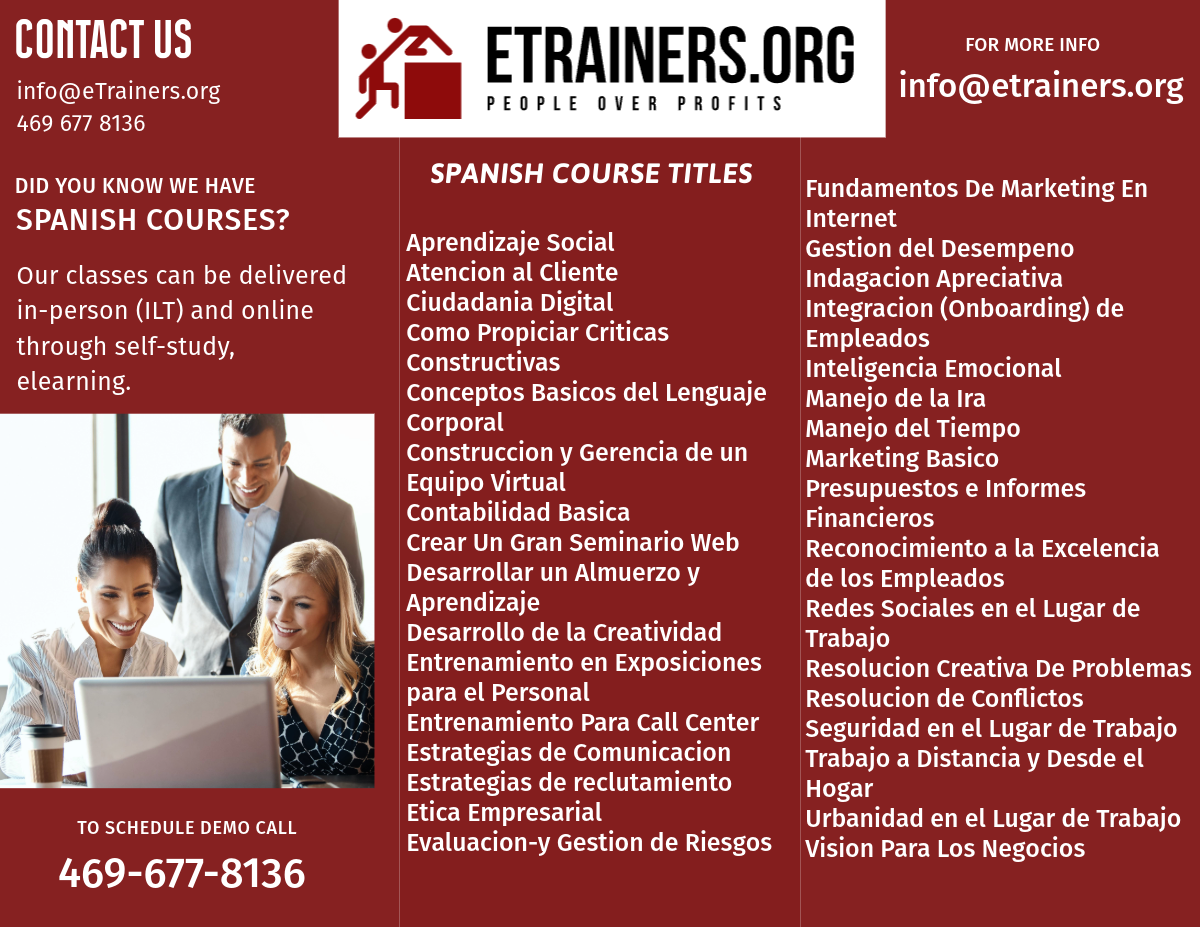
    Visit our Learning Solutions Library for Spanish course descriptions and objectives.

    Book your meeting for your hands-on exploration of our courses.

    Home
    Are you not sure where to start?

    Start with our skill gap assessments – they are in Spanish too.

  • Breaking Down Learning Barriers with Spanish Courses

    Breaking Down Learning Barriers with Spanish Courses

    Why Spanish-Language Training Courses Matter for Your Workforce

    When it comes to workplace safety, compliance, and operational excellence, clear communication isn’t just important—it’s essential. Yet for millions of Spanish-speaking frontline workers across the United States, critical training often arrives in a language that creates barriers rather than bridges.

    The solution? Spanish-language training courses designed specifically for the industries and roles where they’re needed most.

    The Reality: A Diverse Workforce Deserves Inclusive Training
    According to the U.S. Bureau of Labor Statistics, Hispanic and Latino workers make up a significant and growing portion of the American workforce—particularly in manufacturing, construction, warehousing, and other frontline industries. Many of these workers are bilingual, while others are more comfortable learning and retaining information in Spanish.

    Here’s the challenge: when training materials only exist in English, comprehension gaps can emerge. And in high-stakes environments where compliance violations carry hefty fines and safety lapses can cost lives, those gaps become serious risks.

    The bottom line? Offering training in your employees’ preferred language isn’t just a nice gesture—it’s a strategic investment in your organization’s safety, efficiency, and legal standing.

    Start with our skill gap analysis (Spanish version).

    Sign up to view our Spanish course descriptions and objectives, and schedule your personal tour of our catalog.

    Book a 15-minute call:

  • Group Coaching and Customizations – Our Minimum Delivery Standards

    Group Coaching and Customizations – Our Minimum Delivery Standards

    The Prerequisite for Practice

    When organizations embark on change initiatives, training often becomes the default destination—a checkbox to mark complete before moving on. But in the ATCM model, Training (the “T”) serves a fundamentally different purpose: it’s the prerequisite for practice, not the end goal.

    This distinction matters more than you might think. When we treat training as the finish line, we burden employees with exhaustive content dumps, marathon workshops, and information overload that leaves them too fatigued to actually apply what they’ve learned.


    The Problem with Traditional Training Approaches

    Let’s be honest about what’s broken:

    Cognitive overload is real. Research consistently shows that our working memory can only hold so much before new information starts pushing out what we just learned. Yet traditional training programs routinely ignore this, cramming hours of content into single sessions.

    Change fatigue compounds the problem. Your employees aren’t just dealing with this training—they’re navigating competing priorities, ongoing operational demands, and often multiple change initiatives simultaneously. Every minute spent in non-essential training is a minute stolen from meaningful work.

    The forgetting curve is unforgiving. Within 24 hours, people forget approximately 70% of new information. Within a week, that number climbs to 90%. So why do we design training as if a single exposure creates lasting competence?


    eTrainers.org’s eLearning Approach

    The solution isn’t more training—it’s smarter, more purposeful training that respects both cognitive science and business realities.

    Microlearning: The Foundation Framework

    Instead of comprehensive courses that cover everything, purposive eLearning focuses on delivering the basic framework—the essential knowledge scaffolding employees need to begin practicing effectively.

    Think of it this way: you don’t need to memorize an entire cookbook to make dinner. You need to understand basic cooking principles and have a recipe handy. Training should provide the principles; practice develops the expertise.

    Effective microlearning modules:

    • Target 5-15 minutes of focused learning
    • Address one concept or skill at a time
    • Provide immediate relevance to daily work
    • Create space for reflection and application

    Right-Sizing Content to Business Impact

    Not all knowledge carries equal weight. Purposive eLearning demands that we ruthlessly prioritize:

    High PriorityLower Priority
    Skills directly tied to workflow changesBackground theory and history
    Decision-making frameworksEdge cases and exceptions
    Core processes and protocolsNice-to-know supplementary content
    Compliance essentialsAdvanced techniques (save for later)

    By focusing training on high-impact workflow redesign, organizations ensure employees spend their learning energy where it matters most.


    Strategic Benefits of Purposive Training

    1. Preserved Energy for Practice

    When training is lean and focused, employees arrive at the practice phase with mental bandwidth intact. They’re ready to experiment, make mistakes, and build genuine competence—rather than simply trying to remember what they learned in a three-hour webinar.

    2. Faster Time to Application

    Microlearning modules can be deployed rapidly and consumed immediately before task execution. This “just-in-time” approach closes the gap between learning and doing, dramatically improving retention and transfer.

    3. Reduced Resistance to Change

    Change fatigue often masquerades as resistance. When employees face yet another lengthy training requirement, their pushback isn’t about the content—it’s about the burden. Purposive eLearning respects their time and intelligence, reduces friction, and builds goodwill.

    4. Measurable Business Outcomes

    Because purposive training ties directly to specific workflow changes, its impact becomes measurable. You can track whether employees successfully apply the framework in practice, rather than simply whether they completed a course.


    Building Your Purposive Learning Strategy

    Ready to transform your approach to the Training phase? Here’s where to start:

    Audit existing training for content that doesn’t directly support immediate application. Archive it for reference, but remove it from required learning paths.

    Map training to specific practice scenarios. Every module should answer: “What will the learner do differently after this?”

    Embrace flexibility. Self-paced, device-agnostic learning allows employees to engage when their cognitive resources are highest—not when a calendar invite demands it.

    Support hybrid and remote realities. Today’s workforce needs training that travels with them, accessible on any device, at any time.


    The Bottom Line

    Training isn’t transformation—it’s preparation. When we design the “T” phase of ATCM with this understanding, we create learning experiences that energize rather than exhaust, that focus rather than overwhelm, and that ultimately serve the business outcomes we’re chasing.

    The goal isn’t employees who’ve completed training. It’s employees who are ready to practice.


    Ready to Build a Smarter Training Library?

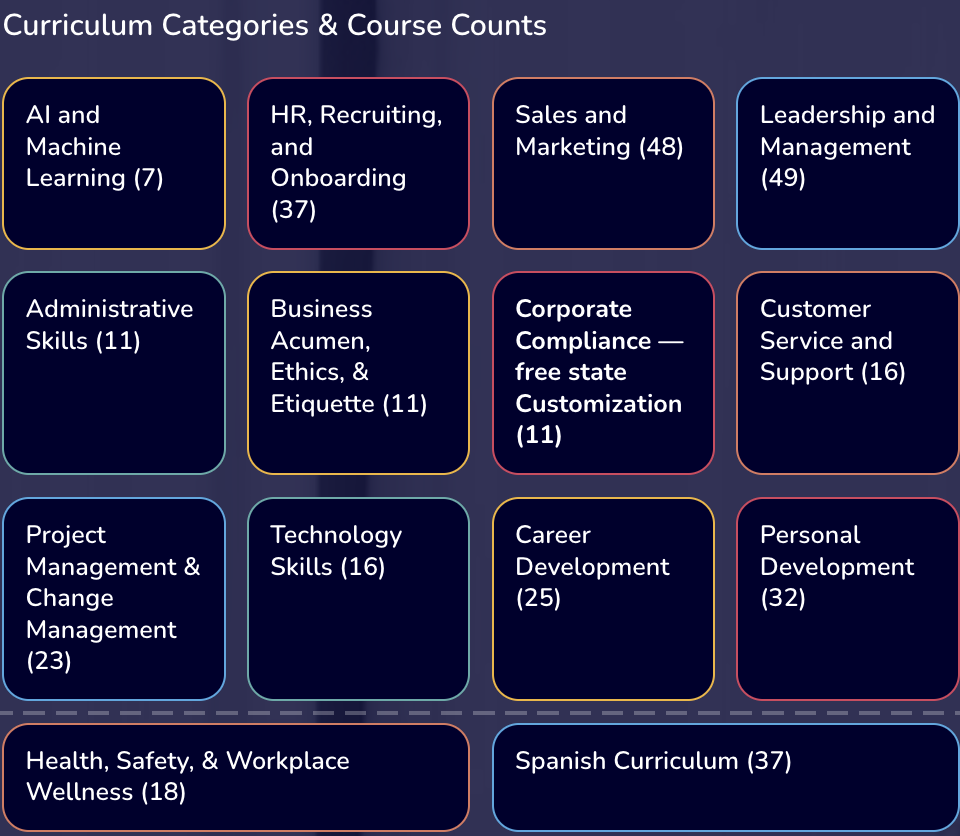
    Transform your workforce with affordable, focused learning solutions. The eTrainers.org Learning Solutions Library offers unlimited access to over 340 courses across today’s most in-demand competencies—from AI and machine learning to leadership, compliance, and beyond.

    At just $19.99/month per user, your team gets:

    ✓ Self-paced, microlearning-friendly content

    ✓ Flexible access on any device

    ✓ Categories spanning leadership, technology, project management, and more

    ✓ Solutions for enterprise, SMB, government, and nonprofit sectors

    Explore the Learning Solutions Library →

    Stop training for training’s sake. Start building the purposeful foundation your workforce needs to practice, adapt, and excel.

  • The Complete Guide to Measuring Training Effectiveness

    The Complete Guide to Measuring Training Effectiveness

    eTrainers.org Launches Revolutionary ATCM Model to Transform Professional Development

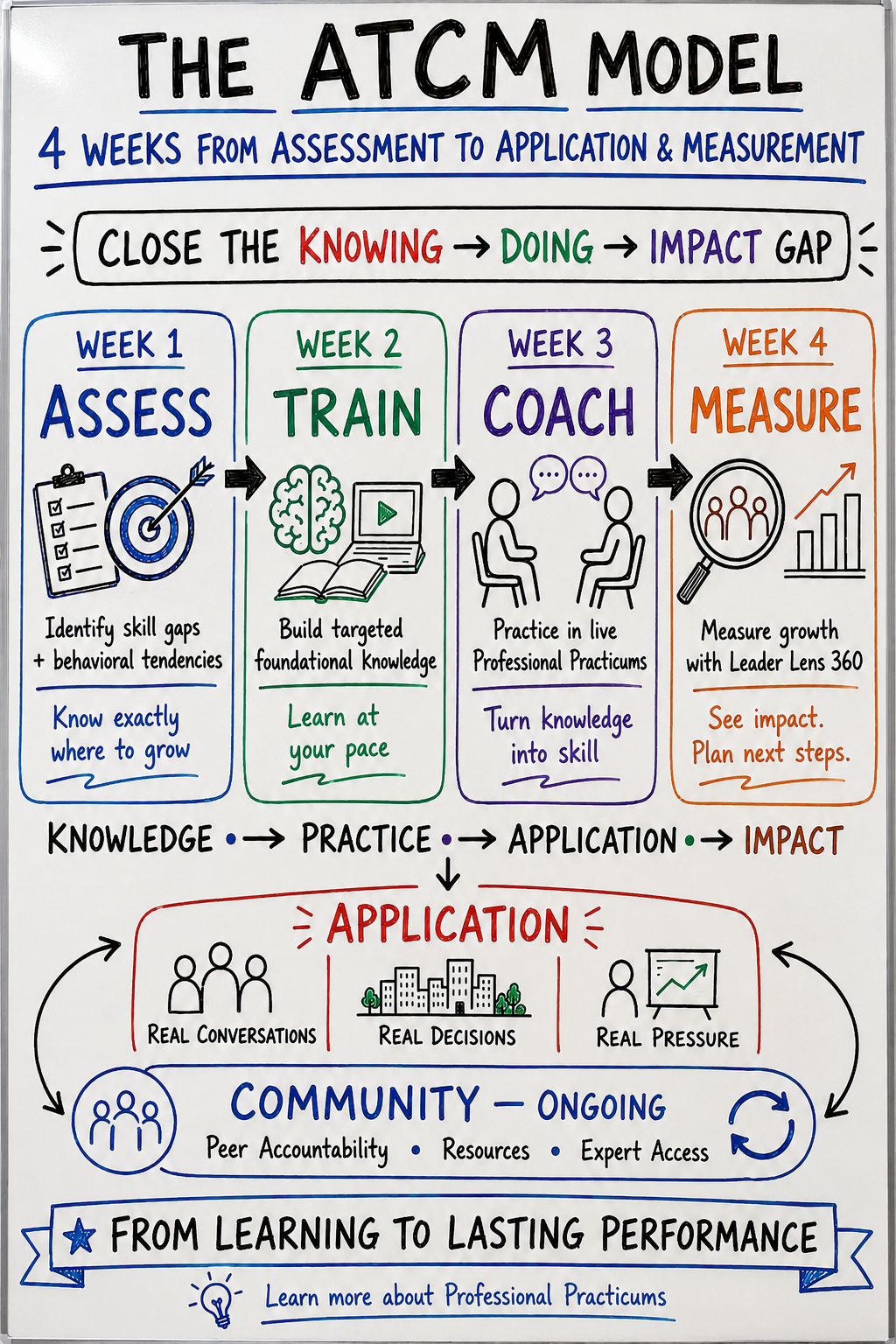
    September 8, 2026 – eTrainers.org is excited to announce the official launch of the ATCM Model, a comprehensive four-phase framework designed to revolutionize how organizations approach employee training and professional development when measuring training effectiveness.

    Introducing the Assess – Train – Coach – Measure Model

    The ATCM Model provides a structured, cyclical approach to learning and development that ensures continuous improvement and measurable results. The four pillars of the framework include:

    • Assess – Evaluate current skill levels, identify gaps, and establish baseline performance metrics to create targeted development plans
    • Train – Deliver customized learning experiences and educational content tailored to address identified needs
    • Coach – Provide ongoing support, mentorship, and real-time guidance to reinforce training and support practical application
    • Measure – Track progress, evaluate outcomes, and analyze data to demonstrate ROI and inform future development cycles

    A Holistic Approach to Learning

    “Traditional training programs often fail because they lack follow-through and accountability,” said a spokesperson for eTrainers.org. “The ATCM Model closes the loop by integrating assessment, training, coaching, and measurement into one continuous cycle. This ensures that learning translates into real-world performance improvements.”

    Why ATCM?

    Organizations implementing the ATCM Model can expect:

    • Higher training ROI through targeted interventions
    • Improved employee performance with ongoing coaching support
    • Data-driven insights to guide future development investments
    • Sustainable growth through continuous feedback loops

    Availability

    The ATCM Model launches on September 8, 2026, and will be available to organizations of all sizes. For more information about implementation, certifications, and resources, visit eTrainers.org.


    Media Contact:
    eTrainers.org
    Email: info@etrainers.org
    Website: www.etrainers.org


    Book a 15-minute session to learn more.

    Home
  • Assessment Center Services for Workforce Skills

    Assessment Center Services for Workforce Skills

    Why Assessments Are Your Secret Weapon Against Workplace Anxiety


    Change is hard. We all know this. But here’s what makes it even harder: walking into the unknown without a map.

    When organizations introduce new technologies—especially AI—employees often find themselves caught between excitement and fear. Will this tool help me work smarter, or will it replace me entirely? This isn’t paranoia. It’s a legitimate concern shared by 53% of employees who worry about being replaced by emerging technologies.

    The good news? There’s a proven way to transform that fear into confidence. It starts with something surprisingly simple: a diagnostic assessment.


    The Power of Knowing Where You Stand

    Effective change doesn’t begin with training. It begins with understanding.

    Think about the last time you learned something new. Whether it was a software platform, a teaching methodology, or a professional skill, the process probably felt overwhelming at first. Now imagine if someone had shown you exactly what you already knew and precisely what you needed to learn. Suddenly, that mountain looks more like a manageable hill.

    This is the principle behind diagnostic assessments, and it’s why the “Assess” phase of the ATCM (Assess, Train, Coach, Measure) model is so critical. Before anyone opens a training module or attends a workshop, we first need to establish a baseline. What skills do your people already have? Where are the gaps? What specific knowledge will move them from where they are to where they need to be?


    Connecting Assessment to Awareness: A Cognitive Bridge

    If you’re familiar with the ADKAR model—Awareness, Desire, Knowledge, Ability, Reinforcement—you know that awareness is the essential first step. People need to understand why change is happening before they can embrace it.

    Here’s where things get interesting: the “Assess” phase of ATCM acts as the cognitive foundation for ADKAR’s “Awareness” phase.

    When employees complete a thoughtful diagnostic assessment, several powerful things happen:

    1. They see their current capabilities clearly. This isn’t about highlighting weaknesses—it’s about creating an honest picture of their professional landscape.
    2. They understand what they need to learn. The mystery disappears. Instead of vague anxiety about “learning AI,” they know they need to master three specific skills.
    3. They recognize the gap is manageable. When the unknown becomes known, fear shrinks. A concrete learning path replaces the terrifying void of uncertainty.

    In other words, assessment doesn’t just inform training—it builds psychological safety.


    Reducing the Cognitive Load of the Unknown

    Let’s talk about cognitive load for a moment.

    When employees face organizational change without clear information, their brains work overtime trying to fill in the gaps. What will this mean for my job? How much do I need to learn? Am I capable of this? What if I fail?

    This mental energy drain doesn’t just cause stress—it actively impairs learning. People operating from fear and uncertainty have fewer cognitive resources available to actually acquire new skills.

    By conducting skill gap assessments upfront, you’re essentially clearing the mental clutter. You’re saying to your team: “Here’s exactly where you are. Here’s exactly where you need to go. And here’s exactly how we’re going to get you there.”

    That clarity is liberating. And liberated learners are effective learners.


    Addressing the Replacement Fear Head-On

    Remember that 53% statistic? More than half of employees fear being replaced by AI and automation. This fear is the elephant in every training room when organizations roll out new technology initiatives.

    Diagnostic assessments address this fear in a surprisingly direct way. When you assess employees before training, you’re sending a clear message: we’re investing in developing you, not replacing you.

    Think about it from the employee’s perspective:

    • If the organization planned to replace them, why bother identifying their skill gaps?
    • If they were expendable, why create a personalized learning pathway?
    • If their growth didn’t matter, why measure their starting point at all?

    Assessment is an act of commitment. It says, “We see you, we value you, and we’re going to help you grow alongside this technology.”


    Targeted Training: The Efficiency Advantage

    Beyond the psychological benefits, diagnostic assessments deliver a powerful practical advantage: targeted training interventions.

    Without assessment, organizations often default to one-size-fits-all training programs. Everyone sits through the same modules, regardless of their existing knowledge. The result? Some employees are bored because they already know the material. Others are overwhelmed because the training assumes knowledge they don’t have. Nearly everyone is disengaged to some degree.

    With a proper diagnostic approach:

    • Advanced learners can skip foundational content and focus on advanced applications
    • Beginners receive the scaffolding they need without feeling rushed
    • Everyone spends their learning time on content that actually moves the needle

    This isn’t just better for the learner—it’s better for the organization. Targeted training accelerates onboarding velocity, getting employees productive faster while consuming fewer resources.


    Preventing the Organizational Plateau

    Here’s a pattern we see repeatedly: Organizations launch AI initiatives with great enthusiasm. There’s excitement, investment, and momentum. Then, somewhere around the 60-70% implementation mark, progress stalls.

    Welcome to the organizational plateau.

    Why does this happen? Often, it’s because the easy adopters have adapted, but the remaining employees—those with greater skill gaps, more fear, or less clarity about expectations—haven’t been equipped for success.

    Diagnostic assessments prevent this plateau by ensuring no one gets left behind from the start. When you understand everyone’s baseline, you can design learning pathways that bring your entire team along. You identify who needs extra support before they become bottlenecks. You create success conditions for every learner, not just the quick adopters.

    The result is smoother implementation, sustained momentum, and AI projects that actually reach their full potential.


    Putting This Into Practice

    Ready to build assessment into your change management approach? Here’s how to get started:

    1. Design Assessments That Inform, Not Intimidate

    Your diagnostic should feel like a helpful tool, not a test that could affect someone’s job security. Frame it as a way to personalize learning, not evaluate performance.

    2. Share Results Transparently

    When employees complete assessments, give them clear feedback. Show them their strengths, their growth areas, and how their personalized training plan addresses each gap.

    3. Connect Assessment to Purpose

    Help employees understand why you’re assessing before training. Explain the benefits—more relevant learning, faster skill development, and a clearer path forward.

    4. Use Assessment Data to Build Confidence

    Celebrate existing competencies, not just gaps. When employees see what they already bring to the table, they approach new learning from a position of strength.

    5. Reassess and Celebrate Progress

    Follow up with post-training assessments that demonstrate growth. Nothing builds confidence like tangible evidence of advancement.


    The Bottom Line

    Effective change management isn’t about pushing people through training and hoping for the best. It’s about meeting people where they are, understanding what they need, and creating clear pathways to success.

    The “Assess” phase isn’t just a preliminary step—it’s the foundation that makes everything else possible. It turns awareness from a vague understanding that “change is coming” into concrete knowledge: “I know exactly what I need to learn, and I can do this.”

    When you reduce the cognitive load of the unknown, you free up mental resources for actual learning. When you address replacement fears through demonstrated investment in development, you build trust. When you target training to real skill gaps, you accelerate results.

    And when you do all of this from day one, you set your AI initiatives—and your people—up for genuine, lasting success.


    At eTrainers.org, we believe that effective learning starts with understanding. Our diagnostic tools and personalized learning pathways help organizations navigate change while empowering every employee to thrive.

    Ready to build your foundation for fearless change? Visit our Competency Assessment Center

  • Dr. Harman on Learning Science

    Dr. Harman on Learning Science

    Why Your Training is Failing to Stick

    And the science-backed model that actually changes behavior


    The Uncomfortable Reality L&D Leaders Need to Face

    Your organization spent six figures on that learning management system. Your team produced polished video modules. Your completion rates look impressive in quarterly reports.

    And yet—nothing has changed on the job.

    This isn’t a content problem. It’s an architecture problem. And until we confront it honestly, we’ll keep pouring budget into digital assets that collect dust while performance gaps persist.

    Dr. Philippa Hardman’s research delivers an inconvenient truth: traditional video tutorials and quizzes have negligible impact on actual behavior change. The “watch-and-quiz” model that dominates corporate training creates an illusion of learning while failing to produce what matters—skill execution when it counts.


    The Knowing-Doing Gap: Where Your Training Budget Goes to Die

    Here’s what the science tells us:

    • Learners forget up to 70% of training content within 24 hours without structured practice
    • Knowledge recall (passing a quiz) and skill application (performing under pressure) are fundamentally different cognitive processes
    • Passive consumption—no matter how engaging the video—doesn’t build the neural pathways required for automatic, in-the-moment execution

    The result? What I call the “infrastructure tax”—the hidden cost organizations pay when L&D spend fails to convert into job-site execution. You’re not just losing the training budget. You’re losing:

    • Performance gains that never materialize
    • Development velocity as teams plateau despite completing courses
    • Organizational learning as the same mistakes repeat across departments

    Most training stops at knowledge transfer—presenting information, assessing recall, and calling it complete. But knowing something and being able to use it in a high-stakes real-world moment are fundamentally different skills.


    Why Behavior Change Requires More Than Information

    Dr. Hardman’s research points to a critical insight: learning that sticks occurs when information is embedded in a stable, repetitive context that fosters habit formation.

    Think about how you actually developed your most reliable professional skills. It wasn’t through watching a video once. It was through:

    • Repeated practice in realistic conditions
    • Feedback loops that refined your approach
    • Social accountability that kept you engaged
    • Gradual mastery that built genuine confidence

    This is the science of learning transfer—the ability to take what you learned in training and actually use it when stakes are high, time is short, and pressure is real.

    Applying communication frameworks in the moment—not reciting them from memory in a quiz. Making sound judgment calls under pressure, drawing on practiced mental models—not theory. Navigating conflict, negotiation, and complexity the way it actually happens—messy, fast, and consequential.


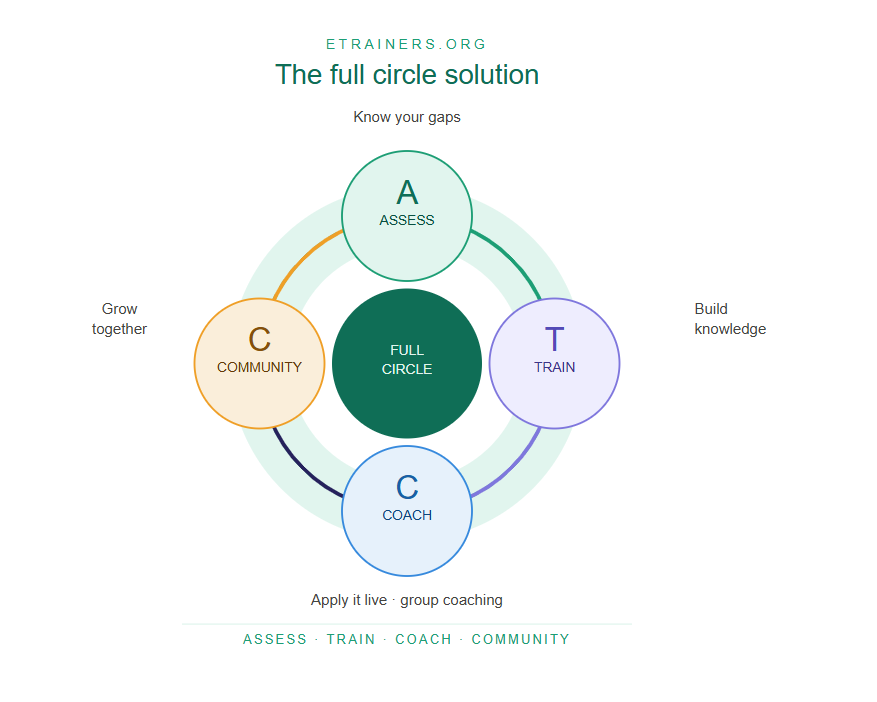
    Introducing the ATC Model: Assess → Train → Coach

    The solution isn’t to abandon digital learning. It’s to embed it within a complete ecosystem where each phase reinforces the next, and no skill falls through the cracks.

    The ATC (Assess – Train – Coach) Model represents a fundamental shift from content delivery to behavior architecture:

    Phase 1: Assess

    Most training programs assume everyone needs the same thing. The ATC Model starts differently—with a rigorous diagnostic designed to surface exactly where each learner needs to grow.

    Rather than assigning generic content, you build a development path that is precise, efficient, and directly tied to real performance gaps. No filler. No wasted time. Just targeted growth where it matters most.

    Phase 2: Train

    Build foundational knowledge through structured online learning—at your pace, on your schedule. This is where traditional e-learning fits, but only as one component of a larger system, not the entire solution.

    Phase 3: Coach

    This is where the ATC Model diverges dramatically from conventional training. Professional Practicums—live, group coaching sessions—ensure learners don’t just review what they’ve studied; they immediately apply it.

    Through structured role plays, realistic case studies, simulated conversations, and real-world problem solving, participants build the muscle memory that makes skills stick. This isn’t passive consumption. It’s active, guided practice—with peers facing the same challenges under the same pressures.

    What gets practiced:

    • Real negotiation dynamics—finding leverage, managing concessions, reaching agreements under pressure
    • Simulated interpersonal and team conflicts using frameworks in the heat of realistic scenarios
    • Complex, ambiguous business challenges with time constraints and competing priorities
    • Difficult professional conversations—from feedback delivery to executive communication

    Sustain: The Learners’ Lounge

    Skills built in isolation fade. Skills built in community compound.

    The ongoing community component provides peer accountability, continued access to frameworks and facilitated discussions, and engagement with coaches beyond formal sessions—because real growth doesn’t follow a schedule.


    The Business Case: Eliminating the Infrastructure Tax

    When training converts to execution, the ROI math changes entirely:

    Traditional TrainingATC Model
    High completion, low applicationTargeted development with verified transfer
    Generic content for everyonePrecision diagnostics driving personalized paths
    One-time event, rapid decaySustained practice and community reinforcement
    Knowledge measured by quiz scoresSkills measured by job-site behavior

    The ATC Model eliminates the infrastructure tax by ensuring every dollar spent on learning development produces measurable change in how people actually perform their jobs—not just what they can recall on a test.


    The Architecture Matters More Than the Content

    AI can build training. AI can test knowledge. AI can generate content faster than any human team. But knowledge alone has never changed behavior. Learning transfer does.

    The gap between knowing and doing is where most training programs fail—and where real ROI is lost. The cost isn’t just wasted budget. It’s missed performance, stalled development, and teams that keep making the same mistakes despite completing required training.

    Stop investing in training that stops at knowledge. Start building the skills your teams need to perform—in real conversations, real decisions, and real pressure.


    Ready to close the knowing-doing gap in your organization?

    Learn more about the ATC Model →


    This analysis draws on Dr. Philippa Hardman’s research on learning transfer and the science of behavior change in corporate learning environments.

    Home
    Do you have a learning community?

    Yes, visit us on Skool

  • AI for Leaders

    Speak the Language, Make Sharper Decisions

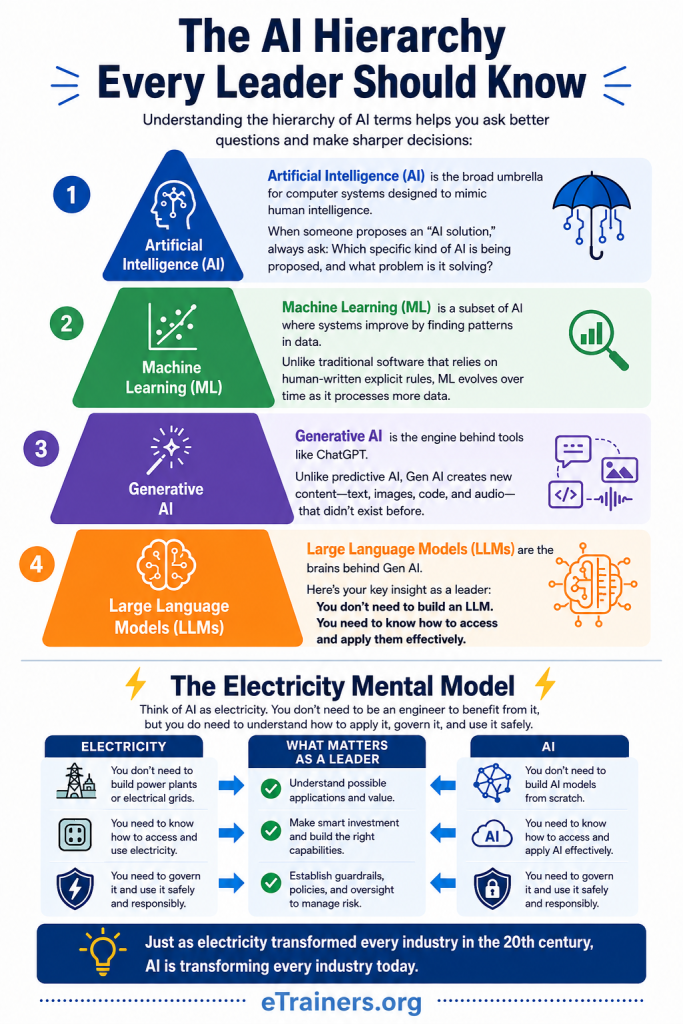
    Artificial intelligence isn’t just a technical project—it’s a leadership imperative. Yet many executives feel lost in a sea of jargon, unable to distinguish buzzwords from business-critical concepts. If you want to lead confidently in the age of AI, you first need to speak the language.

    The AI Hierarchy Every Leader Should Know
    Understanding the hierarchy of AI terms helps you ask better questions and make sharper decisions:

    Download our free AI Resources for Leaders.

    Your Action Item: In your next AI conversation, ask which specific type of AI is being proposed and what business problem it solves. This simple question will immediately elevate the quality of the discussion.

    Home
    Do you have AI Training for Leaders?

    Yes! We offer the course only to current clients because we know they have met organizational readiness.